
 |
| (Image by Zak Shelby-Szyszko / Zeal Images) |
A couple of months ago, I presented a recording at BYOV that was new to me by a musician who certainly wasn’t. It was an LP by woodwind player extraordinaire and Saturday Night Live bandleader Lenny Pickett called Lenny Pickett and the Borneo Horns (Carthage Records, 7001 (1987)).
Here’s the BYOV in question and the reaction from the crew: BYOV # 5.
I had been listening to the record regularly prior to the meeting and the record hasn’t strayed from the turntable since.
The record was intriguing to me for a number of reasons apart from being a fun listen. Though Pickett has been recognized as a tremendous soloist, bandleader and collaborator throughout his varied career, Borneo Horns has stood alone as his only recording as a leader. The record was also a testament to its time, one of much experimentation in instrumental groupings, compositional techniques and genre mixing.
My curiosity was peaked enough that I thought I’d reach out to Mr. Pickett and see if he would give me some background on the recording. He was extremely generous and sent me an astounding amount of information concerning his development as a musician and events that led up to and through the recording. His extended quotes are italicized.
So here we go. Gonna try to shed a little light on a record that should be more well known.
***
Some background.
The Early Years
Lenny’s family moved to the Bay Area from New Mexico when he was two years old. His father was stationed at White Sands Proving Ground and worked on the Nike Zeus missile project for the Air Force. The family moved to Berkeley, California after, while Lenny’s father finished his graduate studies.
His first introduction to music was when he started playing clarinet at 9 years of age. Lenny had some group and private lessons in the fourth grade but remained self-taught for the rest of his musical development, except for a handful of lessons on classical clarinet repertoire and flute.
With very rare exceptions, all of my training was extremely informal. It is my belief that most music is learned through self-study. I also believe that we all learn through emulation, so no one is ever completely self-taught. In my case, formal music education just wasn't available, and I worked with what I had.
Pickett’s introduction to the saxophone came at a very turbulent time in his life. His parents split up a few years after they moved to California. Before the 8th grade, Lenny had run away from his father’s home and spent a summer in a juvenile detention center. He was living in a foster home at the beginning of the school year and, while his academic attention waned, his involvement in music became almost all consuming.
A fortunate break came when a sympathetic band teacher, a Miss Magneson, allowed Pickett to borrow and take home one of the school’s tenor saxophones. He was drawn to the sax because of the loud sound that was more suitable for the music that Lenny and his peers were drawn to, namely jazz, rock, blues and R&B. His playing became a necessity for him.
I practiced like crazy on my own. Outside in the park, in parking garages, down by the bay, up in the hills…. I got chased away and yelled at. My friends got curious about what I was up to. I had quit going to school and socially disappeared for the most part. Eventually my fellow young musicians gathered me up and included me in their bands.
Much of Pickett’s musical education came through hanging with other musicians and picking up useful tidbits from conversations, casual jams, etc. His mother’s second husband was a little known jazz trumpeter named Tommy Warren, whom Pickett was able to spend valuable time with and from whom he learned a great deal about jazz and its history. Another musical acquaintance was saxophonist Bert Wilson, who lived down the street from Pickett.
Wilson’s story should be covered in more detail. He was certainly an inspiring character as he had contracted polio as a young child, discovered jazz at 10 by listening to Charlie Parker and pursued a career in music that led him from the avant-garde scene of Los Angeles to New York (where he recorded with Sonny Simmons and James Zitro for ESP), then back to California.
I hung out with Bert a lot. We had 2 or 3 "formal" lessons (nothing was ever that formal with Bert), and then we spent time together. The few saxophone lessons that I had with Bert were my only lessons on that instrument. He was very accepting and welcoming to me, and though we didn't have a rigorous lesson plan, I do consider him to be one of my teachers.
 |
| Bert Wilson |
About Wilson’s “experimental” bent and its effect on his pupil:
I was pretty "experimental" when I met Bert. (Ask him.) Having had no real saxophone lessons, I had figured out a lot of things on my own that weren’t part of the normal saxophone training. Bert was a perfect fit for me. I loved the freedom that Bert espoused and I enjoyed his presence. Bert is a very disciplined musician with a formidable technique. It’s through his massive ability that he can play with the level of freedom that he does. We still keep in touch.

Pickett joined the horn driven, funk group Tower of Power when he was 18 years old. The group toured two thirds of the year. They recorded their own albums and as a for hire horn section on the side, taking up much of the young Pickett’s time. Pickett gives credit to bandleader Emilio “Mimi” Castillo for helping him learn “the craft of recording through working on our album projects.”
The saxophonist’s compositional style sprouted from his experiments in the recording studio. Pickett had learned the rudiments of notation while studying the clarinet but really began composing in earnest in the mid 1970s after purchasing a modular synthesizer and 8-track tape recorder under the advisement of Dr. Patrick Gleeson (of Herbie Hancock’s Mwandishi band fame). The use of these electronic tools allowed Pickett to overdub his own woodwind lines with those of the modular synth, which could provide a vast array of sounds and textures for patient practitioners.
 |
| Gleeson with Hancock |
My acoustic music is often a translation of tape music ideas into the realm of acoustic instruments. I’m interested in fluid interactions between all technologies. Pencils and score paper are examples of older technologies that had a huge impact on how western art music was created. Graphic ideas invaded what was once an entirely aural medium. I have used the direct manipulation of recorded sound and the manipulation of the graphic representation of sound fairly equally.
Pickett grasped the complexities of arranging for multiple horns through his early work with woodwind ensembles (like that of Tower of Power) and his relationships with other musicians.
Writing for wind instruments was never really a problem. My earliest playing experiences were in wind ensembles. I am also, as you may have noted, an annoying interrogator of my fellow musicians. I always try to explore the technique and mechanics of the various instruments that I am around. Over the years, I have accumulated a pretty good knowledge of how they all work. I have read up on the acoustic properties of all the instruments in the orchestra and I have studied their various notational oddities.
New York
After a decade on the road as a member of Tower of Power, Pickett moved with his young family (including an infant son) to New York City in 1981. The move made it possible for him to settle his family in a place where there was a tremendous amount of opportunities for a professional musician.
Kathryn Rae, Pickett’s wife, had lived in New York during the 1970s, performing as a member of Andrew DeGroat’s modern dance company. DeGroat had been the choreographer for the first production of Phillip Glass’s “Einstein on the Beach.” Rae used the contacts from this production along with those stemming from her ties with one time roommate Garrett List, trombonist and booker of famed performance center The Kitchen. These connections proved helpful in Pickett’s professional musical pursuits, including his landing a part in the Saturday Night Live band.
The Borneo Horns
 |
| Steve Elson |
During the early 1980s, Pickett was involved with David Bowie as an arranger and member of the touring band alongside his old friend and fellow saxophonist Steve Elson. The two had known each other since junior high school and had a deep musical rapport. Bowie was in the midst of recording and touring in support of a handful of dance-oriented records, the most famous being the Nile Rodgers (of Chic fame) produced Let’s Dance. On the 1983 “Serious Moonlight Tour,” Pickett met saxophonist Stan Harrison. The triumvirate became the nucleus of The Borneo Horns. Pickett gives credit to Rodgers and Bowie as catalysts to the group’s inception.
While on tour with Bowie, Pickett began writing music for this small woodwind ensemble. It was convenient to have these two extremely talented musicians at such close proximity. The group gelled quickly and Elson, Harrison and Pickett began to tour as a unit throughout Europe and North America.
 |
| Stan Harrison |
We also functioned as a horn section on quite a few commercial pop records in the '80s and the early ‘90s. We played a lot together and there is a crazy level of empathy and telepathy between us. We still get together from time to time. We are very good friends.
Added a short while later, the fourth member of the group was Leroy Clouden who Pickett had originally met while touring with Tower of Power but played with after his arrival in New York while sitting in at a jam session at Kenny’s Castaways in Greenwich Village. Pickett: “I thought of him immediately when I had the idea of adding a percussionist to the saxophone trio. His time is awesome.”
The music stemming from the fringes in New York during that time period was all over the map. Curious mixtures of classical, punk, jazz, dance, blues, -- you name it -- were the call of the day. The compositions that Pickett wrote for the Borneo Horns weren’t intended to play to the vanguard of trendy eclecticism; they were natural extensions of his musical personality.
 |
| The Borneo Horns |
I have played in many different situations (circus, rock tours, Broadway, bar bands, street bands, etc.), playing many different styles and genres of music. This is what freelance musicians do. I enjoy a vast array of music and I have been influenced by my own sonic experience of the world in the way that all musicians and composers are.
I enjoy adapting to the various musical circumstances that I find myself in, but when I am making up my own new music, I just ask myself: “What would I like to hear now?”
Though there were some contemporaries working along similar lines during this time, Pickett said that he hadn’t heard either the World Saxophone Quartet or ROVA until well after his work with the Borneo Horns. He wasn’t surprised that similar concepts were being explored at the time, however.
The saxophone lives in a strange world. It's neither fish nor fowl. Not brass yet not quite a woodwind. The saxophone has never been fully embraced by classical music or by the classical orchestra and, outside of the jazz world, the saxophone has a poor reputation. This can sometimes seem confining. It is, however, an amazing instrument with huge possibilities that have only been partially explored. Those groups that you mention are fellow explorers.
The music that the group performed was likened by Downbeat magazine to “sound like collaborations between Bach, King Curtis, Steve Reich and the World Saxophone Quartet.”
The Recording


The Borneo Horns had been performing and touring for a few years before they received the attention of record producer and folk musician Geoff Muldaur. Muldaur had heard a live recording of the group on the Columbia University radio station WKCR and had been excited by the possibility of working with the group. Pickett was put in contact with Muldaur by his good friend trumpeter Peter Ecklund.
Eager about the recording potential of the Boreno Horns, Muldaur pushed the idea to the legendary record producer Joe Boyd.
Geoff got very excited about the project and pushed for it to happen, and got it off the ground before anybody figured out what he was up to. He had a lot to do with the choice of studios and casting the members of the larger ensemble. Geoff and I are still very good friends.
The record would be released on Carthage Records, a subsidiary of Boyd’s Hannibal label. The label was mainly a folk label featuring releases from the Incredible String Band, Richard & Linda Thompson and Fairport Convention. The Borneo Horns recording would be the label’s lone outlier in the world of jazz/modern/whatever.
Pickett was already well acquainted with the co-producer, Hal Wilner. Wilner had established himself as an extremely talented musical producer for recordings, film and live performance. He was also involved in music coordination (“needle drop duties”) at Saturday Night Live, where he met Pickett who was then assisting the former musical director Howard Shore.
Hal is a genius at knowing what is needed from a producer. He always provides no less than what is needed and no more. Perfect. I could not have had better help with my project. He has amazing ears.
Though the resulting Lenny Pickett and the Borneo Horns album was a huge experiment presenting a wide array of sounds and compositional styles, the recording process itself was rather old fashioned.
We recorded the “Borneo Horns” album old-school-style direct to full-track stereo on a Studer tape deck. There was no possibility of “punching-in” or overdubbing to fix mistakes, but there are some edits here and there. This was the same method that classical records and jazz projects used before multi-track recording was available. Amazingly, the tempo was always rock-solid between successive takes, and the editing was incredibly easy. We recorded the project in this way to minimize tape hiss and avoid the generation loss that happens when multi-track tape is mixed to 2-track. Also, musicians perform differently when they know that they can’t easily replace their mistakes, and the ensemble effort is greatly improved. Paul Wickliffe engineered and Bob Ludwig mastered. It sounds awesome.
The majority of the album was recorded at Skyline Studios in New York City. The tape recordings used on “Solo for Saxophone and Tape” were recorded at Grog Kill Studio in Mt. Tremper, New York by engineer Tom Mark.
The album was released in 1987 on both LP and CD.
The Compositions
Many of the compositions on Lenny Pickett and the Borneo Horns were written for use in performances of David White’s Dance Theater Workshop (DTW) of New York City (now a part of New York Live Arts) or for specific dance festivals/events. Pickett used inspiration from innumerable sources for the creation of these soulful, infectious and rhythmic excursions. He cited these sources as especially integral: “… the Ongo music from Central Africa, the Rising Star Gospel Quartet, Sly and the Family Stone, old blues 78’s…”
All of the “Dance Music for Borneo Horns” selections on the recording were written for the DTW in January 1985. The series has continued to grow to over 40 compositions for the Borneo Horns (#4, #6 and #13 were recorded later on drummer Dennis Chambers album Planet Earth). The compositions that made the album were selected by producer Hal Wilner.
 “Dance Music for Borneo Horns #1” was written in a sort of canon with inversions and lot of call and response between the horns. The tune featured Elson on baritone sax, Harrison on alto and Pickett on tenor. Leroy Cloudon held everything in place on trap kit.

The song is a funky, mid-paced and infectious. The music sounds as if it is a blend of New Orleans parade music and Bach chorale. A very interesting exercise on horn ensemble writing with emphasis on rhythmic movement.
The second track was a piece that most directly relates to Pickett’s work with electronics. “Solo for Saxophone and Tape” was also written for use by the DTW and captured the spirit of the 20th Century electronic music that used tape editing as compositional process. The principle sonic material was made up of overdubbed tapes that Pickett recorded at Grog Kill. The tapes included a wide range of woodwinds that were used as the harmonic bed to the track that Pickett recorded on tenor separately at Skyline.
Here’s more info on how Pickett recorded the piece:
I made the piece originally to be performed in a concert. As I remember it now, I created a recording with 7 processed slap tongued clarinets on my 8-track tape recorder, mixed it and transferred it to a ¼-inch half-track stereo tape, made a tape loop, recorded the tape loop back onto 2 tracks of a new 8-track tape, and then added another group of clarinets (double b-flat contra-bass, bass, b-flat and e-flat). I remember that I liked the idea that all of the sounds on the tape portion of the piece were made using stopped cylindrical air columns, and consequently were largely missing any even integer partials.
We remade the piece for the album, and added the flutes when the project got bumped up to 24-track tape. In that instance I used the primitive samplers that were available at the time to remake the "tape loop" on 7 separate tracks. In the spirit of this type of work, we recorded the solo live to 1-inch full-track stereo while we rolled the "tape" (in this case the 24 track master played back through the SSL console), so that the “solo” is first generation audio on the full-track master.
The taped parts were written conventionally, scored on paper and played straight through. The saxophone part was partially notated with a good deal of improvisation added.
“Dance Music for Borneo Horns #2” has the same horn set up as “#1” but includes Roger Squitero on bongos to accentuate Clousen’s traps. Pickett had known Squitero since his days in Berkeley and began to perform with him frequently after his move to New York City with the group Night Flight. The additional percussion gives the tune a certain Latin/Afro-Cuban flare. Harrison’s alto has a particularly moving segment as the lead voice. The ensemble writing is extremely strong on this trickily syncopated composition. This piece was written for performances at Jacob’s Pillow Dance Festival and the Maine Festival in 1986.
Half of the album was dedicated to pieces for a larger ensemble. Pickett had always been good at meeting and inviting new musicians to take part in projects. The additional horn players that were added were tuba virtuoso Howard Johnson, trombonist/tuba player Dave Bargeron and the great trumpet duo of Laurie Frink and Nelson Bogart.
 |
| Howard Johnson |
I met Dave Bargeron working in the studios as a session musician, but I also remember subbing in the Gil Evans Big Band while Dave was doing that. Dave subsequently played with me on several other projects of mine. He is one of the most versatile brass players that I’ve ever heard.
I think that I met both Laurie Frink and Nelson Bogart playing in bands on Bleeker Street. Laurie has an amazing range and has become a very important trumpet teacher. Nelson doubles on guitar and is also a music attorney (!).
“Septet #2 for Seven Winds and Percussion” was used as part of the music for Marta Renzi’s “Marriage Between Zones Three and Four” presented by DTW. Pickett wrote the piece using his saxophones, a wind-controlled synth and his 8-track recorder (he was limited to a septet because he needed the last input for the click track). This piece was the second section to a three-part piece.
There are internal sections in each of the three movements in which several musical phrases of differing lengths overlap each other and eventually resolve. This was a fairly common approach among many composers who got their training in classic electronic music studios. It mimics processes (sequencers, tape loops, etc.) that are the normal tools of electronic composition. It’s very easy to do with tape. It was a little bit tricky to learn with the group.

What about that banjo?
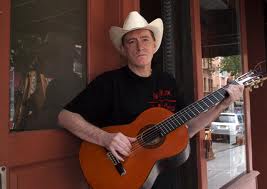
That's actually my banjo. I bought it so that I could get Ned to play it. Ned is a great classical guitarist with many commissioned works created for him. Consequently, he reads "fly shit". (Ned has worn many hats and has in recent years written several important books that focus on the music of the African diaspora.) I knew that he’d do justice to any idiosyncratic writing I came up with. (Ned said some of his notes looked like “upside down telephone poles".)
 |
| Ned Sublette |
“Dance Suite Section D” was a short piece that featured the large ensemble in a short study that was a part of a larger piece. Listen for that very low BBb tuba and some lovely writing for the horns.
“Dance Music for Borneo Horns #4” was written as a wild imitation of circus music. The horns blow wildly before settling on the quick, jaunty carousel ride melody. Altissimo screams were unleashed in a melee of exuberance. The exceptionally wild lead up to the diminished ending segment proved to be one of the most memorable moments on the album.
“Dance Suite Section 1” contained the most prominent use of banjo and an almost pop like sensibility. The harmonic and rhythmic texture supplied by the banjo was a great addition. This piece most clearly represented the sound that Pickett would have been leaning toward with his arrangements for art-rock group the Talking Heads. Very colorful and esoteric.
The last of the featured series, “Dance Music for Borneo Horns #5” was written specifically for Stephen Petronio’s dance “Number Three.” The slinky, winding tune echoed R&B sentimentality with Pickett’s tenor as the lead vocalist. This composition was used as a feature for all the saxophonists in a solo setting. Elson’s resonant baritone solo and Harrison’s strident alto really gave a wide dynamic variety to the composition. The tempo and feel were a real departure from the majority of pieces on the album, making the piece very poignant.
The final piece on the album “Landscape” brought back the larger ensemble plus banjo. Brass swells and walking tuba bass lines provided a marching band aesthetic.
The piece is built around the melodic fragment that begins the section after the short introduction. It is mostly a development of that short motif. (Eric Richards, a composer friend of mine, has often critiqued my work over the years and he was always encouraging me to develop my music by expanding upon modest materials.)
Much of my music from the time of the Borneo Horns album uses very short phrases that are treated in a variety of ways. Sometimes I would change a rhythmic emphasis or invert a melody or use imitation in another part to sustain a simple idea over a longer period of time
I also often leave some aspect of my compositions open for improvisation. If I remember correctly, the drum parts were largely improvised. Both Roger and Leroy are great improvisers.
Lenny Pickett and the Borneo Horns has remained the only release under Pickett’s name. It was a collection of styles and collaborators that showcased the saxophonist’s eccentric mindset and huge ambition. A record that should be more well-known.
***
 |
| (Image by Zak Shelby-Szyszko / Zeal Images) |
The performance is usually the key to any music’s success. I believe that music can reside in one’s head, and it can be carefully and precisely written down, but until the musicians play it, it doesn't really exist. Fortunately, I have been surrounded by amazing players, and I have had the immense good fortune to encounter generous creative musicians that have freely shared their knowledge with me.
I believe that community is everything. Certainly, without community, music is nothing. I think that the value of community probably applies to everything that is worth pursuing.
***
I'd like to sincerely thank Mr. Pickett for taking the time to answer my questions so thoroughly. The detail he provided was extraordinary and really helped me get a handle on this material. Hopefully, the Borneo Horns sophomore record will come out soon.


